
Human-driven cars spend about 95% of their time parked. But autonomous electric vehicles (A-EVs) operating as taxis could serve more passenger miles per year than individually owned vehicles. So, even when half of all cars remain human driven, more than 90% of all driving could be by A-EVs. You will not need to give up your car.
Explore the evidence...
- A journey in an electric Transport-as-a-Service (TaaS) vehicle requires no investment other than downloading a phone application, and there are no penalties for taking one journey. The service can be tried at will and the option to cease to use TaaS is always available (it has high “trialability”). See the graph below to understand the factors affecting consumer choices between individually owned internal combustion engine (ICE) vehicles and A-EVs. Read more on p24-25 of our report Rethinking Transport.
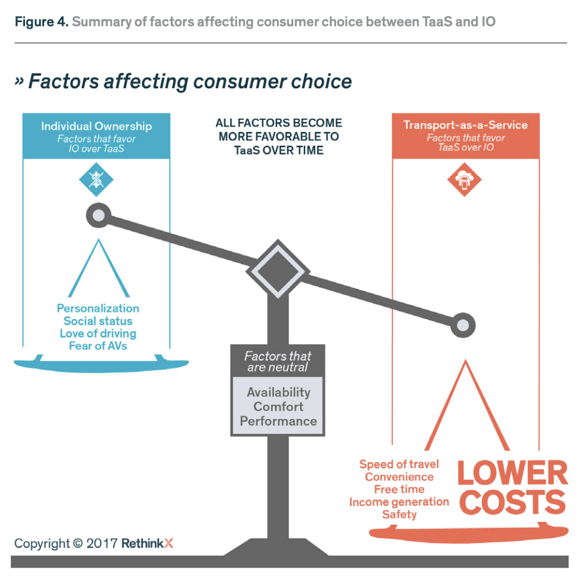
- The scale of the cost differential will be the key determinant of consumers choosing TaaS over independently owned vehicles. See p57 of our report Rethinking Transportation for an explanation of how cost will be the most important factor affecting economic choice.
- By 2030, individually owned ICE vehicles will still represent 40% of the vehicles in the U.S. vehicle fleet, but they will provide just 5% of passenger miles. TaaS, where EV cars are used in fleets, will provide 95% of the passenger miles traveled within 10 years. Read a summary that explains the disruption of transportation, on p6-9 of our report Rethinking Transportation.
- Read our blog post to find out why the illusion of motor car ownership is slowly fading away...
-
Read p15-19 of our report Rethinking Transportation to learn more about the economics of the A-EV and TaaS disruption.
Witness the transformation
Once TaaS has been introduced, consumers purchasing a new car will instead choose to use fleet, owned, on demand TaaS over independently owning an ICE vehicle, for purely economic reasons.
Learn more about the disruption and transformation of the transportation sector.
Published on: 12/07/23
Did this answer your question?