
Our current trajectory places EVs on target to pass cost parity in terms of total lifetime vehicle cost in most regions by the mid-2020s. In some regions (such as China) cost parity has already been reached.
Explore the evidence...
- Cost will be the most important factor affecting economic choice. The scale of the cost differential will be the key determinant of consumers choosing EVs over independently owned vehicles. See the graph below for more detail. Read p57 of our Rethinking Transportation report which sets out the basis for this assumption.
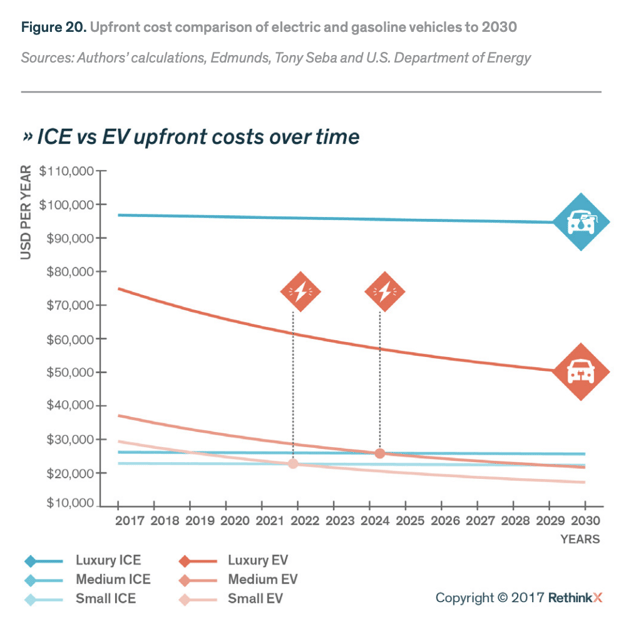
- Autonomous EVs (A-EVs) last five to seven times longer than the average human-driven car, so ride-sharing services and fleets will adopt A-EVs for purely economic reasons. Ride-sharing services, like Uber, will convert to EVs simply because it is the more economically viable thing to do. Watch RethinkX co-founder Tony Seba discuss the two stages—transition to EVs, and then to A-EVs—in more detail here.
- In our 2017 report, we predicted that a 40% yearly improvement rate of A-EVs (slightly slower than Moore’s law) means that A-EVs will be five times safer than human-driven vehicles by 2020, and 10 times safer by 2022. Not only are robotaxi's more economically viable, but they are safer...
- The real disruption of transportation will be through Transportation-as-a-Service (TaaS); where we journey using autonomous and electric vehicles, owned by fleets, not individuals. Watch Tony Seba discuss the TaaS disruption.
- Fleets will go electric because the per-mile cost of EVs is one-third (soon to be one-sixth) the cost of combustion transportation in high-utilization moels. TaaS will rapidly replace the model of individual car ownership and with it the combustion engine. Electric vehicles (trucks, vans, buses and cars) can drive half a million miles (soon to be 1 million) as opposed to around 140,000 miles for combustion vehicles. Companies like Amazon and Fedex will have no choice but to quickly replace their whole fleets with electric trucks and vans for purely economic reasons. Read more about the outcome of forthcoming technology disruptions across our foundational sectors on p45-47 of our report Rethinking Humanity
Why are fleet-driven robotaxis used through TaaS cheaper than individually owned cars?
- 40% TaaS vehicle utilization, 10 times higher than independently owned vehicles.
- TaaS vehicles will drive 500,000 miles over their lifetimes—2.5 times more than internal combustion vehicles.
- TaaS vehicles significantly reduce other operating costs.
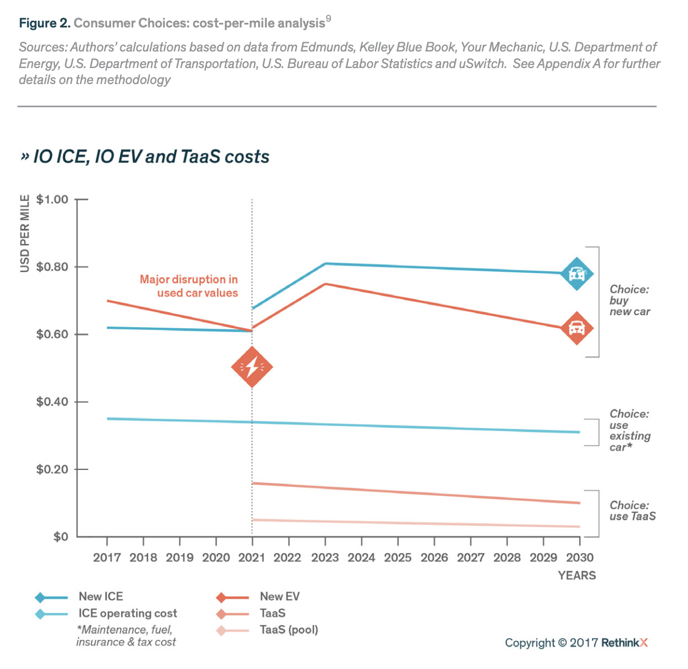
- The graph below shows how consumer choices will affect the cost of each transport option. Learn more about the economics of fleet-driven robotaxis over individually owned individually owned vehicles or EVs on p17-21 of our Rethinking Transportation report).
Witness the transformation
The disruption of transportation will be led by the rise of TaaS. TaaS will become progressively cheaper and improve its functionality, while combustion vehicles will become ever more expensive to operate and harder to use.
Learn more about the transportation disruption.
Published on: 12/07/23
Did this answer your question?