
Long stretches of cloudy winter days when available sunshine is at its minimum are typically the greatest challenge to SWB-based energy systems. However, our research has shown that even in high-latitude regions an SWB-based system optimized for cost needs only a few days' worth of battery energy storage.
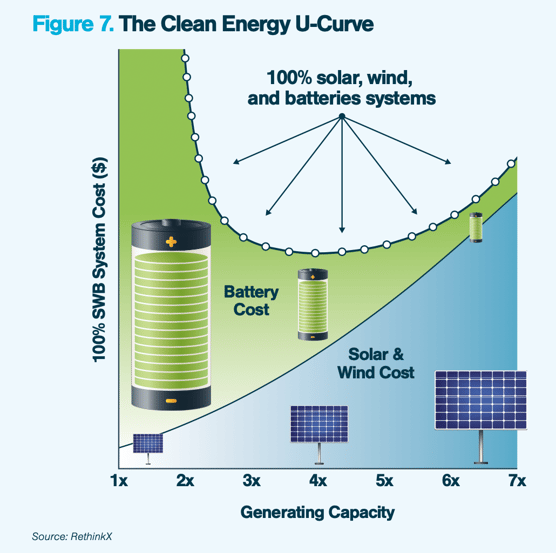
The key to understanding cost-optimization of SWB-based energy systems is the Clean Energy U-Curve.
Explore the evidence...
-
Nowhere on the planet have we found a place that needed more than a few days of storage, regardless of weather variations. The concept of a region needing a whole season of storage is false. Watch this video to find out why from RethinkX co-founder Tony Seba
-
Policymakers, investors, civic leaders and the general public are under the false impression that it is impossible for SWB to supply 100% of a country's electricity without weeks’ worth of battery energy storage. This widespread misconception has been created by the failure of conventional models and forecasts to understand that future solar and wind generating capacity will greatly exceed the total electricity generating capacity operating today. This is a result of an abundance of clean energy SWB Superpower that an SWB system will create. Read more about Super Power on p20-22 of our Rethinking Energy.
-
Not only will SWB be able to cope with weather variations, but a 100% SWB system would naturally produce a very large quantity of near-zero marginal cost super power.
-
As adoption of SWB grows, these technologies will produce an increasingly large surplus of energy at near-zero marginal cost. We call this clean energy super power—or simply SWB Super power for short.
-
This is because the system’s generating and storage capacities must be designed to fully meet electricity demand during the most challenging times of the year, such as the cloudy weeks of winter when the days are shortest. As a result these systems are able to produce much more power throughout the rest of the year. Read more on p20-22 of our Rethinking Energy report.
-
- The amount of battery energy storage required to support a 100% SWB system is much lower than is widely believed. Read more under 2) of our Key Implications on p51 of our Rethinking Energy report.
- In our report, we present data to illustrate that 100% SWB is possible in regions as different as California, Texas and New England as a representative range of solar and wind resources across the U.S. These case studies generalize to nearly all other populated areas of the world, showing the potential for SWB to meet our global energy demand.
- A 100% SWB system is both physically possible and economically affordable, regardless of weather variation. Contrary to the predominant narrative in public discourse worldwide, it is possible to meet all electricity needs with a 100% solar, wind and batteries system in California, Texas and New England–and by extension the rest of the continental United States as well. Moreover, because the majority of the global population lives in areas with more abundant solar and wind resources than New England, it follows that SWB can meet their electric power needs also. Learn more about the key implications of the SWB energy disruption on p51-53 of our Rethinking Energy report.
Witness the transformation
A global clean energy system run by 100% SWB is both possible and inevitable for nations all over the world, regardless of geography and weather fluctuations.
Learn more about the disruption and transformation of the energy sector.
Published on: 12/07/23